
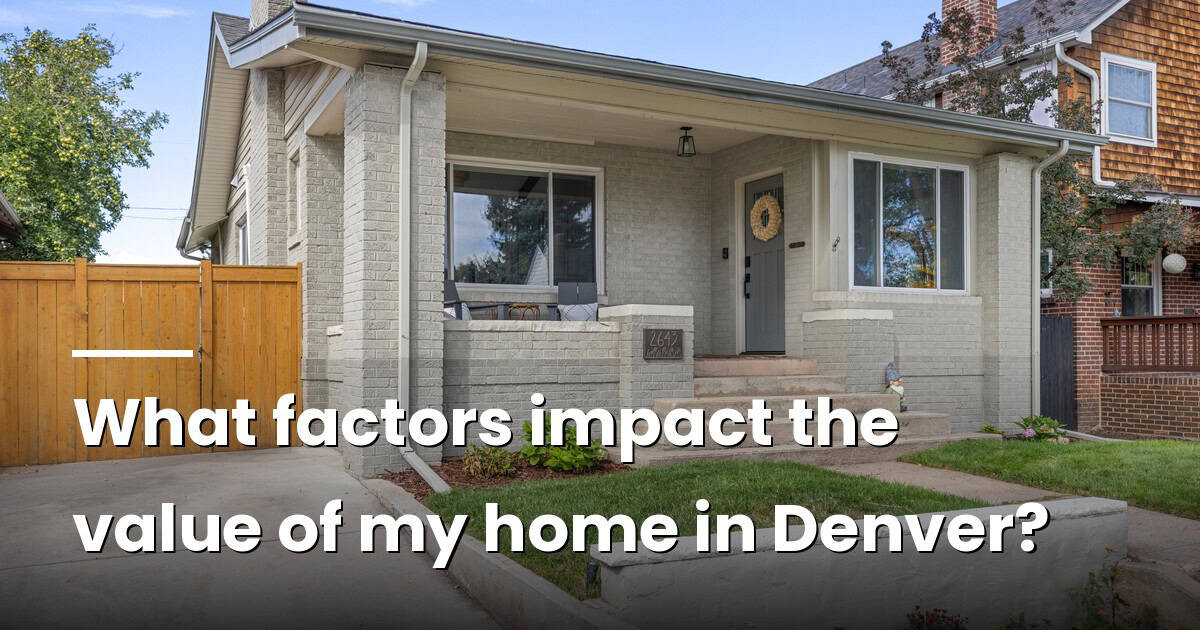
 Clients ask me this constantly, usually right before they're about to spend money on a renovation or right after a neighbor's house sold for a number that surprised them. The honest answer is that your home's value isn't one thing. It's four forces working together: where it sits, what it is, how well it's kept, and what the market's doing when you sell. Here's how I actually think through each one.
Location does more of the work than you'd think
You've heard “location, location, location” a thousand times, but the specifics matter more than the cliché. Homes zoned for highly rated schools can sell for meaningfully more than comparable homes zoned elsewhere, even when the houses themselves are nearly identical. Walkability to grocery stores, parks, and transit adds appeal, especially for those in the Denver metro area. While a home on a busy arterial or backing up to a rail line typically sells for less than the same floor plan on a quiet block a few streets over.
This gets especially local in metro Denver, where elevation, housing stock, and even demand shift block by block. An appraiser working the Front Range will tell you the same property type can perform very differently depending on which side of a boundary it sits on. Proximity to good schools or a foothills view can be worth a meaningful jump in price on its own.
Size, layout, and condition
Square footage gives buyers and appraisers a baseline, and price per square foot is the quick comparison everyone reaches for first. But layout matters almost as much as size — an open floor plan and a primary bedroom on the main floor appeal broadly, while a bedroom you can only reach by walking through another room, or a single bathroom serving four bedrooms, appraises lower no matter how many square feet surround it.
Condition is where I see the most avoidable value loss. Newer homes appraise higher partly because their systems have more life left in them, but a well-maintained older home holds its own. What hurts: peeling paint, stained carpet, cracked tile, water stains, an HVAC system past 15-20 years, or an outdated electrical panel. All of these are easy to notice, which means they're expensive to ignore. Overgrown landscaping and a dirty exterior create the same negative first impression before a buyer even opens the door.
What actually earns its money back
Not every upgrade pays for itself, but a few consistently do. Refinishing existing hardwood floors has been shown to recover roughly 147% of its cost at resale, and installing new hardwood recovers around 118%. Both are among the highest-return projects a seller can make. Even something as small as replacing a worn front door or garage door tends to return its full cost. Contrast that with over-personalized choices. Think bold paint colors, elaborate murals, and themed rooms. These can actually work against you, since they narrow your buyer pool instead of widening it.
The market itself is a factor
Your home's value isn't just about your home. Comparable sales, what similar homes nearby actually closed for recently, set the baseline that everything else gets adjusted against. Inventory matters too: fewer homes on the market gives sellers more leverage, while a flood of listings shifts leverage to buyers. Mortgage rates play a role as well, since higher rates shrink what buyers can qualify for and cool overall demand.
Denver's metro market has held a median sale price in the $650,000s with pricing running around $380 per square foot, and roughly 4% year-over-year appreciation in recent data. This is solid, steady growth rather than the frenzy of a few years ago. That backdrop matters when you're deciding whether now is the moment to sell or the moment to wait.
My take
If you're trying to estimate your own home's value, don't start with a renovation. Let's analyze these four categories and be honest about where yours shines or falls short. You can't change location, but a lot of the condition factors are fixable in a weekend, and the highest-ROI projects (refinishing floors, a new front door, basic curb appeal) are rarely the flashiest ones.
If you want an actual number instead of a guess, that's a conversation worth having as you consider a move. I can pull real comps for your specific block and walk you through what's realistically moving the needle on your home versus what's just noise.


















Socials