
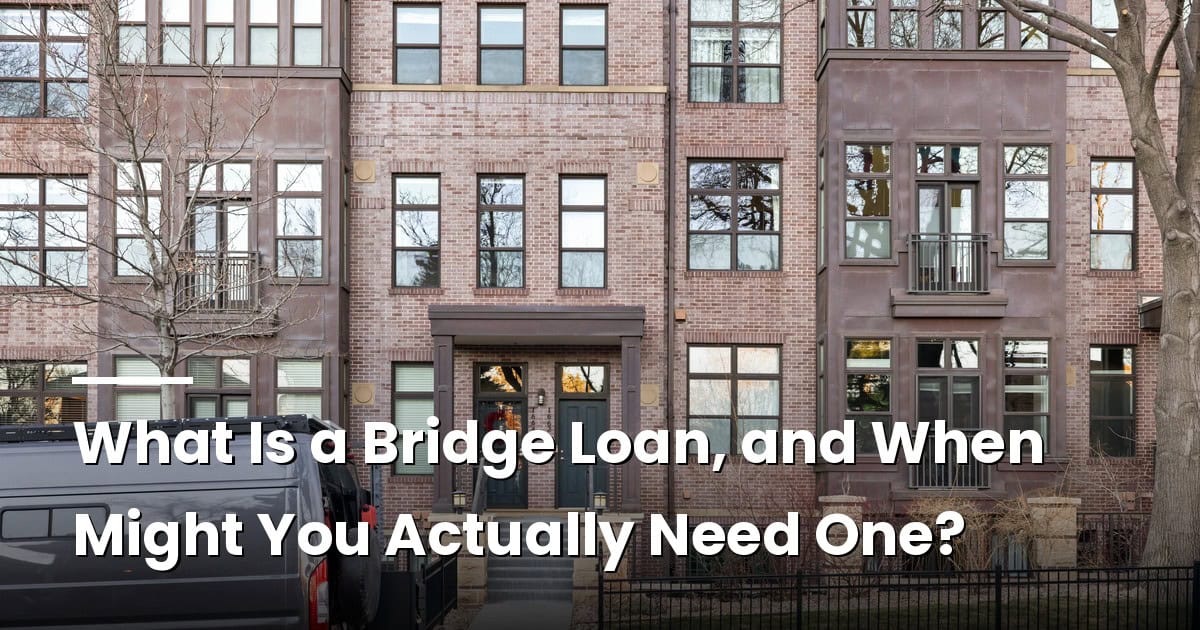
 You found the house. It checks the boxes, it's priced right, and if you wait another two weeks to list your current place first, someone else is going to get it. But your equity is tied up in a home that hasn't sold yet. This is exactly the gap a bridge loan is built for.
I get asked about these more than almost any other financing tool, usually from clients who are torn between buying and selling at the same time. So here's what a bridge loan actually is, how the numbers work, and when I'd tell you to use one versus when I'd steer you toward something else.
What a bridge loan actually does
A bridge loan is short-term financing that lets you borrow against the equity in your current home to cover the down payment and closing costs on your next one, before your current home sells. Your existing home acts as collateral. Once it sells, you pay off the bridge loan with the proceeds.
The appeal is simple: it lets you make a strong, non-contingent offer on a new house without waiting for your old one to close first.
How the math works
Most bridge loans run 3 to 12 months, though some lenders will stretch a term out further. To qualify, you'll generally need:
- At least 15 to 20 percent equity in your current home (some lenders in Colorado ask for closer to 50 percent)
- A credit score in the 650 to 680 range or higher
- Income that can support your current mortgage, your new mortgage, and the bridge loan payment all at once, at least on paper, until the sale closes
That last point trips people up. Lenders want to see that you could theoretically carry three payments simultaneously, even though the whole point is that you won't for long.
Payment structure varies by lender. Some let you make interest-only payments while you're carrying the loan. Others defer everything until your old home sells, which is easier on your monthly cash flow but means a larger payoff at closing.
What it costs
This is the part people underestimate. Bridge loans are priced meaningfully higher than a standard mortgage, typically 1 to 3 percentage points above prevailing mortgage rates, with closing costs running 1.5 to 3 percent of the loan amount for origination, underwriting, appraisal, and title fees.
Run the numbers on a real example: a $350,000 bridge loan can total roughly $381,250 by the time you repay it six months later, once interest and fees are factored in. That's not a reason to avoid one. It's a reason to go in with your eyes open about what “fast and flexible” actually costs.
Who qualifies, and where to look
Beyond the equity and credit thresholds above, most lenders also want your current home actively listed for sale before they'll approve a bridge loan. In Colorado, you'll typically find these through your existing mortgage lender first, then local banks, credit unions, or non-QM and hard-money lenders if your file doesn't fit a conventional box. Not every lender offers them, so this is a good early call to make, not a last-minute one.
The alternatives worth knowing about
A bridge loan isn't the only way to solve the buy-before-you-sell problem, and it's not always the cheapest one.
A HELOC, or home equity line of credit, on your current home typically carries a lower rate and more flexible repayment than a true bridge loan, if you have the equity and the timeline to set one up in advance. A home equity loan gives you a fixed rate and a predictable payment instead. And “buy before you sell” programs, now offered by a handful of companies operating in Colorado, let you unlock your current equity up front without taking on a traditional bridge loan at all. Worth a conversation if the fees above give you pause.
Then there's the simplest option: a contingent offer. In a market where inventory is loosening up in parts of Park Hill, Congress Park, and City Park, a well-written contingency isn't automatically a dealbreaker for a seller the way it might have been a couple of years ago. It's worth pricing out against the cost of a bridge loan before you assume you need one.
When I'd actually recommend one
Honestly, less often than people expect. A bridge loan earns its cost when you've found a home you don't want to risk losing, your current home is realistically going to sell fast once it's listed, and you have the equity and income to qualify comfortably, not just barely.
I, personally, did a HELOC to help fund my home purchase. The trick is that you can't list your old home for sale until after the HELOC closes, so you've got to have your ducks in a row to avoid having the loan open longer than necessary.
Reach out, and we'll run your specific numbers before you're standing in front of an offer deadline trying to figure it out.


















Socials